
Using Citations: A Case-by-Case Guide

Using Citations in Different Contexts
Have you ever created an amazing presentation or designed a beautiful infographic, then returned to the assignment instructions and saw this: For this assignment, you must cite your sources.
You pull out your Unity DE Comm Hub guide for Citing your Sources, and realize that you have an idea of how to cite your sources in written reports, but when it comes to other types of assignments, you don’t know where to begin.
There are many different contexts in which you will need to use citations here at Unity. In the menu below, click on the specific context for which you are trying to cite your sources for a deeper dive on the structure of these citations and examples.
CITING SOURCES IN ACADEMIC WRITING ▶
CITING SOURCES ON POSTERS/INFOGRAPHICS ▶
CITING SOURCES IN PRESENTATIONS ▶
CITING SOURCES ON BLOGS/WEBSITES ▶
CITING/CREDITING IMAGE/GRAPHIC SOURCES ▶



CITING SOURCES IN ACADEMIC WRITING
When to Cite: When you are writing an academic report, essay, or literature review, you should cite your sources any time you rephrase, summarize, or synthesize an idea, fact, or statistic from a source. You should use both in-text citations throughout the paper and a list of full citations at the end of your paper called a references list, or literature cited list.
How it works: Unless specified otherwise, at Unity, we generally use APA formatting for our citations across assignments and especially in academic writing. There are two types of APA citations you will use in your academic writing: in-text citations that go directly at the end of sentences, and full citations, which are placed in a list at the end of your report.
What should it look like?
Click on the source type below for formatting guidance.
Is it an Academic Source?
Academic Sources include peer-reviewed journal articles and original research reports.
In-text Citations for Academic Sources in Academic Writing
- Format: (Author, Year)
- Example: Protecting wetlands plays a crucial role in maintaining biodiversity and natural flood control (Greenfield & Park, 2024).
Full Citations for Academic Sources in Academic Writing
- Format: Author, A. A., & Author, B. B. (Year). Title of the article. Journal Name, Volume Number, Page Numbers. DOI or URL if available.
- Example: Greenfield, J. & Park, W. (2024). Wetland Ecosystem Services. Journal of Habitat Conservation 82, 555-570. https://doi.org/10.1234/envsci.2024.56789
Is it a Website?
You may use websites as a source, as long as you have verified their credibility by checking that they pass the CRAAP Test.
In-text Citations for Websites in Writing
- Format: (Author, Year)
- Use the organization’s name if there is no individual author.
- If there is no date of when the page was published, use “n.d.” for year.
- Try your best to find out when the page was published, as this will help it pass the CRAAP test.
- Example: Many species of bees in Alabama are threatened by pesticide use (University of Alabama, 2020).
Full Citations for Websites in Writing
- Format: Author or Organization. (Year, Month Day). Title of the page. Website Name. URL
- Example: University of Alabama. (2020, June 9). State of the Bees in Alabama. UA Biology Department. https://ua.edu/biology/state-of-al-bees/
CITING SOURCES ON POSTERS/INFOGRAPHICS
When to Cite: Again, just as in academic writing, when you create a poster or infographic, you should cite your sources any time you refer to information from a source. You can do this by directly adding an in-text citation after or under a phrase or fact from your source, then adding a list of full citations at the bottom of the poster.
How it works: We use APA-formatted in-text and full citations on visual communications like posters and infographics. The only difference here is that you may decide to make your citation font size smaller so it doesn’t distract your viewer. Also, it is often best practice to put a full citation in a smaller font at the bottom of your poster or infographic – below we provide examples of how to abbreviate citations for posters/infographics.
What should it look like?
Click on the source type below for formatting guidance.
Is it an Academic Source?
Academic Sources include peer-reviewed journal articles and original research reports.
In-text Citations for Academic Sources on Posters/Infographics
- Format: (Author, Year)
- Example: Climate change affects us all (Goddard, 2015).
Abbreviated Full Citations for Academic Sources on Posters/Infographics
- Format: Author Last Name. (Year). Journal Name.
- Example: Goddard. (2015). J of Climate Science.
Is it a Website?
You may use websites as a source, as long as you have verified their credibility by checking that they pass the CRAAP Test.
In-text Citations for Websites on Posters/Infographics
- Format: (Author, Year)
- Use the organization’s name if there is no individual author.
- If there is no date of when the page was published, use “n.d.” for year.
- Abbreviate where possible.
- Example: Reduce meat consumption to curb greenhouse gas emissions (NIH, 2020).
Abbreviated Full Citations for Websites on Posters/Infographics
- Format: Author or Organization. (Year). URL
- Example: NIH. (2020). https://nih.gov/articles/meat-consumption/
CITING SOURCES IN PRESENTATIONS
When to Cite: Whether you are creating a slide deck or recording a video presentation, you should add in-text citations wherever you reference information from a source on a slide, then add a slide at the end of your presentation for a list of full citations.
How it works: For presentations and slide decks, we use APA formatting for our citations just as in academic writing. In-text citations can be placed at the end of phrases and text on each slide, and full citations can be compiled into a list at the end of your report.
What should it look like?
Click on the source type below for formatting guidance.
Is it an Academic Source?
Academic Sources include peer-reviewed journal articles and original research reports.
In-text Citations for Academic Sources in Presentations
- Format: (Author, Year)
- Example: >80% of plastic waste isn’t recycled (Wu, 2023).
Full Citations for Academic Sources in Presentations
- Format: Author, A. A., & Author, B. B. (Year). Title of the article. Journal Name, Volume Number, Page Numbers. DOI or URL if available.
- Example: Wu, J. (2023). Plastics Pollution Unpacked. Boston: EcoPress 32(4), 445-448.
Is it a Website?
You may use websites as a source, as long as you have verified their credibility by checking that they pass the CRAAP Test.
In-text Citations for Websites in Presentations
- Format: (Author, Year)
- Use the organization’s name if there is no individual author.
- If there is no date of when the page was published, use “n.d.” for year.
- Try your best to find out when the page was published, as this will help it pass the CRAAP test.
- Example: Urban green spaces improve air quality in cities (Lee, n.d.).
Full Citations for Websites in Presentations
- Format: Author or Organization. (Year, Month Day). Title of the page. Website Name. URL
- Example: Lee, T. (n.d.). The importance of urban green spaces. Nature Conservancy. https://nature.org/blogs/urban
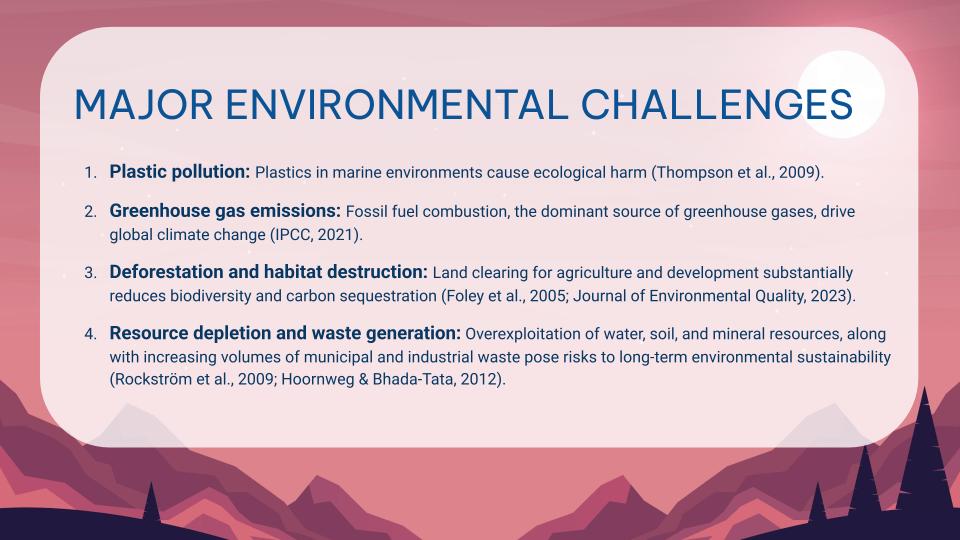
Here is a visual example of in-text citations on a presentation slide:
CITING SOURCES ON BLOGS/WEBSITES
When to Cite: Sometimes we are prompted to create more informal, public-facing communications like blogs and/or websites for our classes. The citation standards we follow when we are creating these types of communications may differ depending on the assignment, so be sure to check the instructions provided in your class.
How it works: Often, it is best practice in these online formats to link directly to the sources we are referring to. This means, rather than inserting an in-text citation at the end of your sentences, you can highlight the relevant text and create a link directly to your source. Additionally, it is often best practice to add a references list of full citations and links at the bottom of your blog post or website.
What should it look like?
Click on the source type below for formatting guidance.
Is it an Academic Source?
Academic Sources include peer-reviewed journal articles and original research reports.
In-text Citations for Academic Sources on Blogs/Websites
- Format: (Author, Year)
- Example: Renewable energy adoption has doubled global carbon emissions reduction efforts in the past decade (Hernandez & Kim, 2025).
Full Citations for Academic Sources on Blogs/Websites
- Format: Author, A. A., & Author, B. B. (Year). Title of the article. Journal Name, Volume Number, Page Numbers. DOI or URL if available.
- Example: Hernandez, L., & Kim, S. (2025). Impact of renewable energy adoption on global carbon reduction. Journal of Environmental Innovations, 12(3), 145-158. https://doi.org/10.9574/jei.2025.1234
Is it a Website?
You may use websites as a source, as long as you have verified their credibility by checking that they pass the CRAAP Test.
In-text Citations for Websites
- Format: (Author, Year)
- Use the organization’s name if there is no individual author.
- If there is no date of when the page was published, use “n.d.” for year.
- Example: Many species of bees in Alabama are threatened by pesticide use (University of Alabama, 2020).
Full Citations for Websites
- Format: Author or Organization. (Year, Month Day). Title of the page. Website Name. URL
- Example: University of Alabama. (2020, June 9). State of the Bees in Alabama. UA Biology Department. https://ua.edu/biology/state-of-al-bees/
CITING/CREDITING IMAGE/GRAPHIC SOURCES
When to Cite: It is always best practice to give credit to photographers and original creators of images, visuals, and graphics we include in our work. Giving them credit, on or near their image, as well as in our references list, ensures that we are not plagiarizing their work. A number of images are copyrighted, so if you were to publish the image, especially without credit, you could face repercussions. Including a citation is necessary if you use images in the following contexts:
- In academic reports
- On posters/infographics
- In presentations
- On blogs/websites
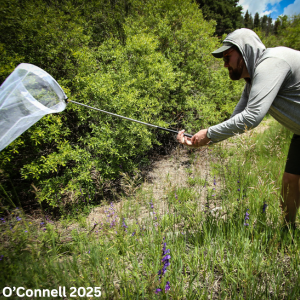
How it looks: For images, an in-text citation will look slightly different. You may choose to write the name of the creator of the image and/or the year of when the image was created directly on the image or below it. If you cannot find the year or site of publication, the minimum is to include the creator’s name. To give full credit, you will want to add a full citation using APA format standards, then add it to your references list.
How do I cite images/graphics?
You may need to search for some meta-information (creator name, publication date, publication site) about the image you would like to use. The following examples are suitable ways to cite images of graphics in your work:
Citing directly on or near the image
- Format: Author Year
- Examples:

Full Citations for Images/Graphics
- Format: Author Name. (Year). Image Name (if available) [type of image]. Publication Site. URL
- Example: O’Connell, M. (2025). Biologist collecting bees [Photograph]. Flickr. https://flic.kr/m/mht987
This guide was created with the assistance of Perplexity AI. All illustrations from StorySet.
