
Derivative as Slope and Rate of Change

The derivative is one of the central ideas in calculus, and it provides a powerful way to describe how quantities change. At its core, the derivative represents two closely related concepts: slope and rate of change. When we think about a function as a curve, the derivative tells us the slope of the tangent line to the curve at any specific point. Unlike the slope of a straight line, which is constant, the slope of a curve can change from point to point. The derivative allows us to capture this variation precisely, giving us a “snapshot” of steepness and direction at a given location.
Beyond slope, the derivative is also understood as a rate of change. In real-world terms, it measures how one quantity responds to changes in another. For example, velocity is the derivative of position with respect to time—it tells us how quickly position changes as time passes. This interpretation extends far beyond physics, appearing in economics, biology, engineering, environmental studies, and many other disciplines.
By connecting the geometric idea of slope with the practical idea of rates of change, the derivative becomes a bridge between mathematics and the real world. It helps us describe, analyze, and predict dynamic processes that are constantly in motion.
The video below provides more details and explanations for calculating derivatives based on rate of change and also introduces the definition of the derivative using a limit based approach.
In calculus, the derivative is one of the most important concepts which is used to measure rates of change. It serves as the mathematical tool that allows us to quantify change, whether in geometry, physics, economics, biology, or countless other fields.
The derivative can be interpreted in two fundamental ways:
- as the slope of a tangent line to a curve, and
- as the instantaneous rate of change of a quantity.
This refresher provides a comprehensive discussion of these interpretations, the difference between average and instantaneous change, the limit-based definition of derivative, and several worked examples.
1. Average vs. Instantaneous Rate of Change
The average rate of change measures how much a function changes over an interval. In algebra, the slope of a straight line is a measure of this rate of change.
If f(x) is a function defined on [a, x], the average rate of change is:
Average rate of change =
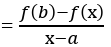
Geometrically, this represents the slope of the secant line connecting the points (a, f(a)) and (x, f(x)) on the graph of the function. We can label this as the slope “m” of the secant line joining these two points, see the figure below:
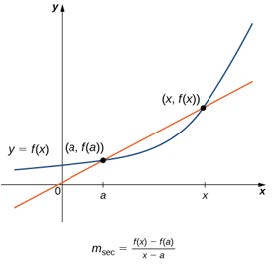
By contrast, the instantaneous rate of change tells us how the function is changing at a single point. To calculate this, we need to use the derivative.
To introduce the derivative, we can use limits to show that the derivative is really a slope but in this case, this will correspond to the slope of a tangent line to a curve.
To begin with, consider a secant line connecting two points on a curve as shown in the figure below:
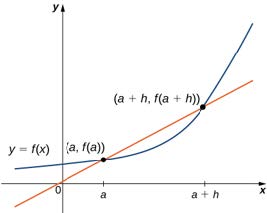
Now , visualize the point (a + h, f(a + h) sliding down the curve, approaching the point (a,f(a). Refer to the figure below:
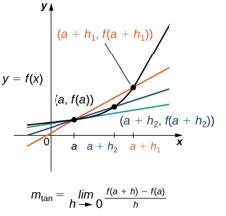
As this happens, the secant lines that are produced as the point moves down the curve will approach what is called the tangent line at the point (a, f(a)). Refer to the figure below:
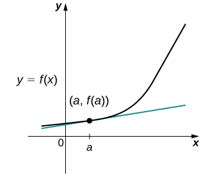
The slope of this tangent line at the point (a, f(a)) is called the instantaneous rate of change at x = a and is defined as the derivative :
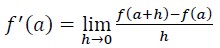
Example 1: Comparing Average and Instantaneous Rates
Let f(x) = x2. We compute:
Average rate of change between x=2 and x=5:
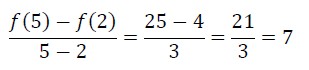
Instantaneous rate of change at x=2:
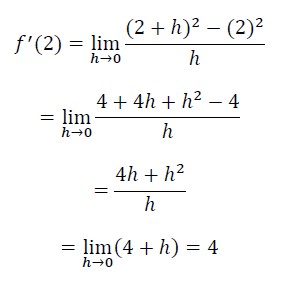
This shows the difference: the average slope across an interval is 7, but the instantaneous slope at x=2 is 4.
2. The Limit Definition of the Derivative
The formal definition of the derivative of f at a point x is:
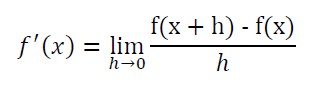
This definition captures the slope of the tangent line to the curve at that point. It is also the fundamental building block from which all differentiation rules are derived.
Example 2: Derivative of f(x) = x2 from the Definition
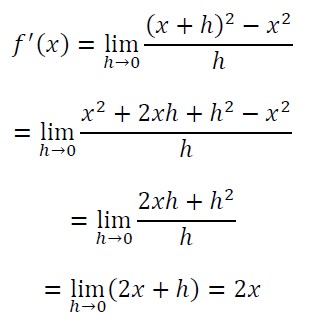
Thus, the derivative of f(x) = x2 is f'(x) = 2x, which gives the slope of the curve at any point.
For example at the point x = 5, the slope of the tangent line to the curve at x = 5 is 2(5) which is 10
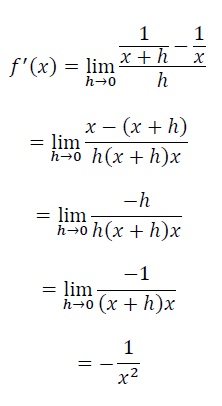
Example 3: Derivative of f(x) = 1/x
3. Graphical Interpretation of the Derivative
Graphically, the derivative at a point corresponds to the slope of the tangent line to the curve at that point. The secant line through two points provides an approximation of this slope, and as the two points move closer together, in the limit, the secant line approaches the tangent line.
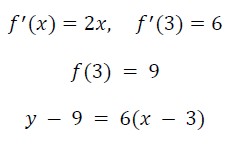
Example 4: Tangent Line Equation
Find the tangent line to f(x) = x2 at x = 3 and write the equation of the tangent line
4. Applications of Derivatives as Rates of Change
Derivatives are powerful tools in modeling real-world change. Some examples include:
- Physics: velocity is the derivative of position with respect to time.
- Economics: marginal cost and marginal revenue are derivatives of cost and revenue functions.
- Biology: growth rates of populations can be modeled using derivatives.
- Engineering: rates of heat transfer, fluid flow, and stress are often expressed with derivatives.
- Environmental Studies: rate of change of pollutant levels after a chemical spill.
Example 5: Physics Application
If s(t) = t2 + 2t is the position of a particle, velocity is:

At t = 3, velocity is v(3) = 2(3)+2 = 8.
Example 6: Economics Application
Suppose cost C(x) = 500 + 20x + 0.5×2. The marginal cost is the derivative of the cost function, which is:
𝐶′(𝑥) = 20 + 𝑥
If production is at x = 100 units, marginal cost is C'(100) = 120.
5. Points Where Derivatives Do Not Exist
The derivative may fail to exist if the graph has a sharp corner, cusp, vertical tangent, or discontinuity at the point of interest.
Example 7: Non-Differentiability at a Corner
Consider f(x) = |x|. At x =0:
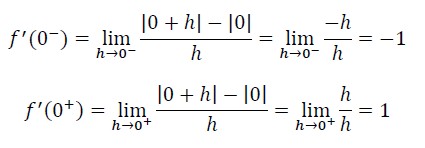
Since the left-hand and right-hand derivatives are not equal, f is not differentiable at x=0.
Conclusion
The derivative unifies the concepts of slope and rate of change, making it one of the most powerful tools in mathematics. From analyzing curves to modeling physical systems, the derivative provides a way to quantify change with precision. By understanding the difference between average and instantaneous rates, mastering the limit definition, and practicing with examples, students build the foundation for more advanced topics in calculus.
