
Derivative Rules
The limit definition to calculate the derivative of a function is time consuming and can be a complicated undertaking for complex functions. Fortunately, there are derivative rules which provide shortcuts for finding the rate of change of more complicated functions without starting from the formal definition each time.
In practice, many functions are not simple polynomials but rather combinations of functions through multiplication, division, or composition. This is where derivative rules such as the product rule, quotient rule, and chain rule become essential.
The product rule allows us to take the derivative of two functions multiplied together by accounting for how each function changes while the other remains intact. Similarly, the quotient rule handles the derivative of one function divided by another. Both rules highlight that derivatives are not simply applied piece by piece; the relationship between the functions matters.
The chain rule is one of the most widely used rules in calculus because it addresses composite functions, where a function uses another function as its input. The chain rule shows how changes propagate through layers of functions, making it fundamental for topics ranging from trigonometry to exponential growth and beyond.
Together, these rules form a toolkit for differentiating almost any function students will encounter, serving as the foundation for applications in science, engineering, environmental studies and economics.
The video below provides more details and explanations for these derivative rules including worked out examples.
1. Introduction to Derivatives
A derivative function provides a means to determine instantaneous rates of change for a function For example, if a function represents the position of a moving object over time, its derivative gives the velocity. If the function describes revenue in terms of sales, its derivative tells us the marginal revenue. In general, the derivative is a mathematical tool to describe sensitivity, trends, and optimization across various applications.
The limit definition to calculate the derivative of a function is time consuming and can be a complicated undertaking for complex functions. Fortunately, there are derivative rules which provide shortcuts for finding the rate of change of more complicated functions without starting from the limit definition each time.
The power rule allows the determination of the derivative function when the original function consists of x raised to a power. The product rule allows us to take the derivative of two functions multiplied together. Similarly, the quotient rule handles the derivative of one function divided by another.
The chain rule is one of the most widely used rules in calculus because it addresses composite functions, where a function uses another function as its input.
This summary reviews key derivative rules that enable efficient determination of derivative functions based on the power rule, product rule, quotient rule, and chain rule. These rules provide methods to differentiate a wide variety of functions without needing to rely on the formal limit definition each time.
2. The Power Rule
The power rule is the most frequently used differentiation rule. It states that if a function is of the form f(x) = xn, where n is any real number, then its derivative is given by:
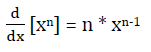
This power rule enables us to differentiate polynomials and many algebraic functions efficiently.
Example 1: Differentiate f(x) = x5.
Solution:
Using the power rule:
f'(x) = 5x4.
Example 2: Differentiate f(x) = 1/x2.
Solution:
Rewrite as f(x) = x-2.
Using the power rule:
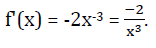
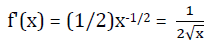
The power rule also applies to fractional exponents.
Example 3: Differentiate f(x) = √x = x1/2.
3. The Product Rule
When differentiating a product of two functions, we use the product rule:

This ensures that the derivative accounts for the change in both factors.
Example 4: Differentiate f(x) = (x2)(sin x).
Solution:
Let u = x2, v = sin x.
u’ = 2x, v’ = cos x.
f'(x) = (2x)(sin x) + (x2)(cos x).
4. The Quotient Rule
The quotient rule is used to differentiate ratios of functions. If f(x) = u(x)/v(x), then:

The rule is similar to the product rule but accounts for the denominator explicitly.
Example 5: Differentiate f(x) = (x2 + 1)/(x).
Solution:
Let u = x2 + 1, v = x.
u’ = 2x, v’ = 1.
f'(x) = (2x·x – (x2+1)(1)) / x2 = (2x2 – x2 – 1)/x2 = (x2 – 1)/x2.
5. The Chain Rule
The chain rule handles composite functions. If y = f(g(x)), then the derivative is:
dy/dx = f'(g(x)) · g'(x).
This expresses the idea that changes propagate through nested functions.
Example 6: Differentiate y = (3x2 + 1)5.
Solution:
Let u = 3x2+1, y = u5.
dy/du = 5u4, du/dx = 6x.
dy/dx = 5(3x2 + 1)4(6x) = 30x(3x2 +1)4.
6. Graphical Interpretations of Derivative Rules
Derivatives describe slopes of tangent lines. For the power rule, the slope grows steeper as exponents increase. In the product rule, the slope reflects simultaneous growth in both factors. The quotient rule reflects how changes in numerator and denominator interact.
7. Applications of Derivatives in Business
In business, derivatives are critical for marginal analysis. For example, the derivative of a revenue function gives marginal revenue, while the derivative of a cost function gives marginal cost. Optimization problems, such as maximizing profit or minimizing cost, rely on these derivative rules.
Example 7: A company’s revenue is given by R(x) = 50x – 0.5x2, where x is units sold. Find the marginal revenue.
Solution:
R'(x) = 50 – x.
Thus, marginal revenue decreases as sales increase.
8. Applications of Derivatives in Environmental Science
In environmental science, derivatives describe rates of change in populations, pollution, and resource consumption. For instance, the derivative of a pollution function can represent the rate at which pollutants are added to a system. Understanding these rates helps guide sustainability strategies.
Example 8: Suppose pollutant concentration follows P(t) = 100(1 – e^(-0.2t)), where t is time. Differentiate to find the rate of change.
Solution:
P'(t) = 100(0.2e-0.2t) = 20e-0.2t.
This shows pollutant accumulation slows down over time.
Additional Applications in Business
Profit Maximization:
Suppose profit is P(x) = R(x) – C(x). To maximize profit, we compute P'(x) = R'(x) – C'(x). Setting P'(x) = 0 gives the point where marginal revenue equals marginal cost. This is a fundamental principle of economics.
Elasticity of Demand:
Elasticity measures responsiveness of demand to price changes. If demand is q(p), elasticity is E(p) = (p/q(p)) * q'(p). Derivatives are essential in calculating this sensitivity.
Example: If q(p) = 500 – 5p, then q'(p) = -5. Elasticity = (p / (500-5p)) * (-5). This shows how demand reacts to price increases.
Additional Applications in Environmental Science
Population Growth Models:
If population follows P(t) = P0 ert, then the derivative P'(t) = rP0 ert = r P(t). This shows that growth rate is proportional to current population.
Resource Depletion:
Suppose a resource declines as R(t) = 1000 – 50√t. Then R'(t) = -25/√t. This indicates that depletion slows down as time passes.
Carbon Emissions:
If emissions follow E(t) = 200(1 – e-0.1t), then the derivative E'(t) = 20e-0.1t. This reveals how quickly emissions are being added over time.
9. Summary
The four main rules of differentiation were reviewed: the power rule, product rule, quotient rule, and chain rule. Each rule provides a method to differentiate complex functions.
Graphical analysis reinforces the geometric meaning of derivatives as slopes of tangent lines. Real-world applications in business and environmental science demonstrate how these derivative rules provide tools for optimization, prediction, and decision-making.
