Tests for Convergence

In many applications, we would like to sum up various terms. For example if you invest monthly in a retirement account, you would like to know the total value of your account at the end of a certain period of time.
It may be the case that we form the sum of infinitely many terms. Even though we are summing an infinite number of terms, this sum can actually converge to a finite number, which we call “convergence” of a series. If a series does not converge to a finite value, we then consider the series to “diverge”. We call the sum of terms a “series”.
In this section we discuss some methods to determine the convergence or divergence of a series.
To determine convergence, we will explore various tests which are applied in different scenarios depending on the nature and format of the series. These test will include test such as test for divergence, alternating series test and ratio test.
The video below provides more details and explanations for these various convergence tests together with several worked-out examples.
In this section we discuss some methods to determine the convergence or divergence of a series.
In some circumstances, we analyze the sum of infinitely many terms. Even though we are summing an infinite number of terms, this sum can actually converge to a finite number, which we call “convergence” of a series. If a series does not converge to a finite value, we then consider the series to “diverge”. We call the sum of terms a “series”.
To determine convergence, we will explore various tests which are applied in different scenarios depending on the nature and format of the series. These test will include test such as test for divergence, alternating series test and ratio test.
A series is a summation of various terms in a sequence and aa series can be either finite or infinite.
A series is usually written with summation notation as follows:
\[ \sum_{n=1}^{k} a_n \]
The value of n = 1 specifies the starting index for the summation and the value of k is the ending index. For example if k = 5, then there would be five terms being added together for this series.
The summation symbol here is the Greek letter “Sigma” which indicates to “sum up the individual terms”.
Expanding this notation we can write the series as:
\[ \sum_{n=1}^{k} a_n = a_1 + a_2 + a_3 + \cdots + a_k . \]
For an infinite series, the upper bound of the summation is shown as “infinity”, as follows:
\[ \sum_{n=1}^{\infty} a_n = a_1 + a_2 + a_3 + \cdots .\]
We sometime refer to a finite series as a “partial sum”. Depending on the value of “k”, a sequence of partial sums can be created. For example, a partial sum can be generated for 5 terms, or for 10 terms or for 50 terms.
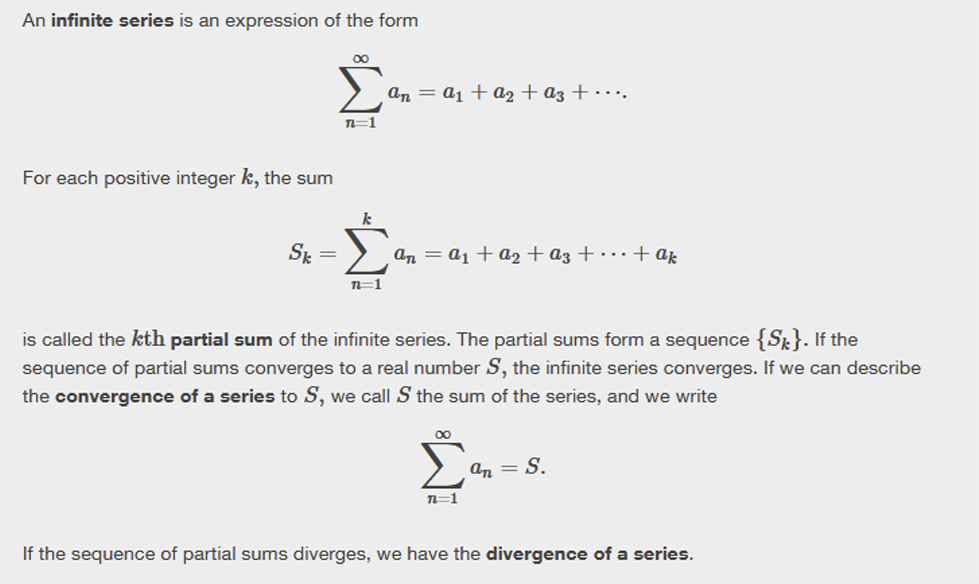
By analyzing this sequence of partial sums, we can determine whether a series converges or not. If the sequence of partial sums converges to a real number, then the infinite series converges.
As an example consider the infinite series as follows:
\[ \sum_{n=1}^{\infty} \left(\frac{1}{2}\right)^{n-1} \]
Various partial sums can be generated such as:
\[ S_1 = 1\]
\[ S_2 = 1+\frac{1}{2} = \frac{3}{2} \]
\[ S_3 = 1+\frac{1}{2}+\frac{1}{4} = \frac{7}{4} \]
\[ S_4 = 1+\frac{1}{2}+\frac{1}{4}+\frac{1}{8} = \frac{15}{8} \]
\[ S_5 = 1+\frac{1}{2}+\frac{1}{4}+\frac{1}{8}+\frac{1}{16} = \frac{31}{16} \]
Here is a table which shows partial sums for larger values of k:
| k | 5 | 10 | 15 | 20 |
| Sk | 1.9375 | 1.998 | 1.999939 | 1.999998 |
Notice as the value of k increases, the partial sums appear to be converging to the value of 2.
Thus we can write that the infinite series converges to 2:
\[ \sum_{n=1}^{\infty} \left(\frac{1}{2}\right)^{n-1} = 2. \]
Here are some formal definitions we will be using as well as the corresponding notation:
An infinite series that appears in many applications is called the harmonic series, which is of the form:
\[ \sum_{n=1}^{\infty} \frac{1}{n} = 1+\frac{1}{2}+\frac{1}{3}+\frac{1}{4}+\cdots. \]
We can form a table of partial sums to investigate where this series converges or diverges.
| k | 10 | 100 | 1000 | 10,000 | 100,000 | 1,000,000 |
| Sk | 2.92897 | 5.18738 | 7.48547 | 9.78761 | 12.09015 | 14.39273 |
Notice from the table, as the value of k increases, the corresponding partial sums Sk do not appear to converge to a specific value. Instead the partial sums appear to be increasing as k increases. Since the partial sums do not converge, we conclude that the harmonic series diverges.
Another infinite series of interest is the geometric series which is of the form:
\[ a+ar+ar^2+ar^3+\cdots=\sum_{n=1}^{\infty} ar^{n-1}. \]
The earlier example: \[ \sum_{n=1}^{\infty} \left(\frac{1}{2}\right)^{n-1}=1+\frac{1}{2}+\frac{1}{4}+\frac{1}{8}+\cdots \]is a geometric series with a = 1 and \( r = \frac{1}{2} \).
When evaluating a geometric series for convergence, examine the value of “r” in the summation
\[ \sum_{n=1}^{\infty} ar^{n-1}. \]
If the absolute value of “r” is less than 1, then the series will converge. If the series converges the convergence value will be \( \frac{a}{1-r} \).
If the absolute value of “r” is greater than or equal to 1, then the series will diverge.
This is summarized as follows:
\[ \sum_{n=1}^{\infty} ar^{n-1}=\frac{a}{1-r} \text{ if } |r|<1. \]
\[ \sum_{n=1}^{\infty} ar^{n-1} \text{ diverges if } |r|\ge1. \]
Since the previous example had an “r” value of ½, we can conclude this series is convergent.
Example:
Determine if the following geometric series converges. If so, find the convergence value of the series
\[ \sum_{n=1}^{\infty} \frac{5}{3^n} \]
Solution
Rewrite the given series as:
\[ \sum_{n=1}^{\infty} 5\left(\frac{1}{3}\right)^n \]
This is a geometric series with a = 5 and \( r = \frac{1}{3} \).
Since the absolute value of r is less than 1, this indicates the infinite series converges, and the series converges to the value
\[ \frac{a}{1-r} = \frac{5}{1-\frac{1}{3}} = 7.5 \]
Divergence Test
The divergence test is a method to determine quickly if a series diverges. It’s important to note that this test will only tell us if a series diverges, but does not provide any conclusion about the convergence of a series.
The divergence test basically looks at the nth term of the series and takes the limit as n approaches infinity. If a series were to converge we would expect the nth term would tend to zero as n approaches infinity. If this is not the case, then would suggest that the series diverges.
So the test takes the limit as n approaches infinity for \( a_n \):
If this limit does not equal 0, or if the limit does not exist, we conclude that the series diverges.
Written in a more formal notation, the Divergence Test is summarized as follows:

Example:
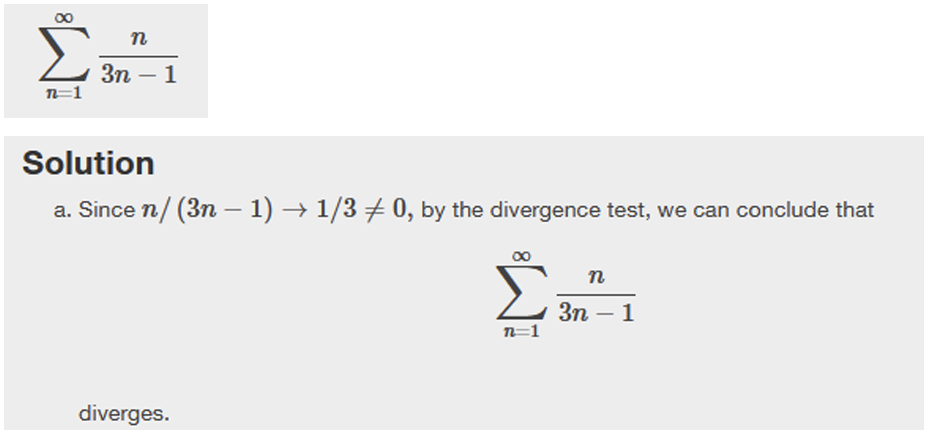
Determine if the following series diverges by applying the divergence test:
Alternating Series Test
In this section, we explore a test to assess convergence for those series whose terms alternate in signs from positive to negative or negative to positive.
Here are two examples of series where the terms have alternating signs:
\[ \sum_{n=1}^{\infty} \left(-\frac{1}{2}\right)^n = -\frac{1}{2}+\frac{1}{4}+\frac{1}{8}+\frac{1}{16}-\cdots \]
\[ \sum_{n=1}^{\infty} \frac{(-1)^{n+1}}{n}=1 -\frac{1}{2}+\frac{1}{3}-\frac{1}{4}+\cdots \]
In the first example, the signs alternate from negative to positive to negative to positive, etc.
In the second example, the signs alternate from positive to negative to positive to negative, etc.
Typically these alternative series include a coefficient of (-1) raised to an exponent which then generates the pattern of alternating signs.
Here are the two typical forms of alternating series that we will encounter:
\[ \sum_{n=1}^{\infty} (1-)^{n+1}b_n = {b_1} – {b_2} + {b_3} – {b_4} +\cdots \]
\[ \sum_{n=1}^{\infty} (1-)^nb_n = {-b_1} + {b_2} – {b_3} + {b_4} – \cdots \]
For an alternating series to converge two conditions must both be met.
a) The (n + 1)st term must be less than the nth term, and
b) The limit of the nth term as n approaches infinity must be equal to zero.
Here is the summary of the alternating series test:
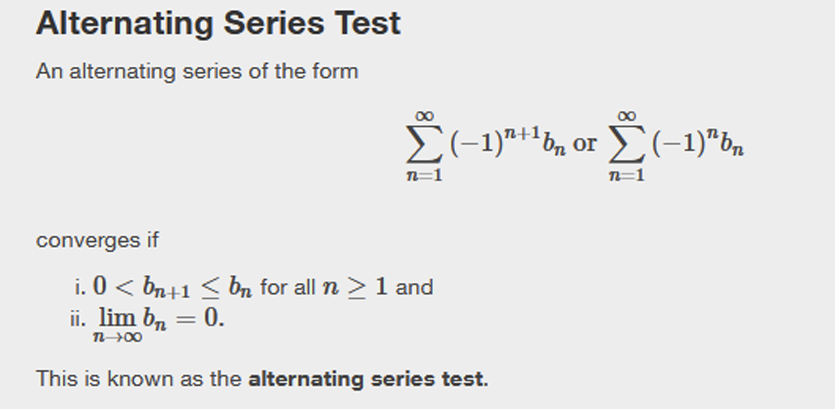
In the notation above, notice that the bn term is that part of the nth term which excludes the coefficient of -1.
Example:
Use the alternating series test to determine if the following series converges:
\[ \sum_{n=1}^{\infty}(-1)^{n+1}/n^2\]
Solution:
The first condition is met since \( \frac{1}{(n+1)^2}<\frac{1}{n^2}\)
The reason this inequality is true is that (n + 1) will always be larger than n, which means that (n + 1)2 will always be larger than n2.
Since these quantities are in the denominator of the fractions we can conclude that \( \frac{1}{(n+1)^2}<\frac{1}{n^2}\)
The second condition is also met since the limit as n approaches infinity of \( \frac{1}{n^2}\) equals 0.
Since both conditions are met, the conclusion is that this series converges.
When considering infinite series, we can evaluate a series and the series formed by the absolute values of each term.
That is, we consider the series: \( \sum_{n=1}^{\infty} a_n \) and the series: \( \sum_{n=1}^{\infty} |a_n| \).
If both of these series converge, then we say that the series \( \sum_{n=1}^{\infty} a_n \) is absolutely convergent.
However if the series \( \sum_{n=1}^{\infty} a_n \) converges, but the series \( \sum_{n=1}^{\infty} |a_n| \) diverges then we say that the series is conditionally convergent.
For example, consider the alternating harmonic series \( \sum_{n=1}^{\infty} (-1)^{n+1}/n \). The series whose terms are the absolute value of these terms is the harmonic series, since \( \sum_{n=1}^{\infty} |(-1)^{n+1}/n| = \sum_{n=1}^{\infty}1/n \). Since the alternating harmonic series converges, but the harmonic series diverges, we say the alternating harmonic series exhibits conditional convergence.
By comparison, consider the series \( \sum_{n=1}^{\infty} (-1)^{n+1}/n^2 \). The series whose terms are the absolute values of the terms of this series is the series \( \sum_{n=1}^{\infty} 1/n^2 \). Since both of these series converge, we say the series \( \sum_{n=1}^{\infty} (-1)^{n+1}/n^2 \) exhibits absolute convergence.
Ratio and Root Tests
There is not a single test of convergence which will work for all series. Part of the challenge in assessing whether an infinite series converges or diverges is analyzing the form of the series and then selecting an appropriate test for convergence. For example we have reviewed several such tests such as the integral test, alternating series test, test for divergence, etc.
In this section, we explore two tests that are especially useful when a series contains a factorial or a general term raised to some exponent. The tests in this section are called the ratio and root tests.
The ratio test is applied by checking the ratio of one term in the series with the next subsequent term in the series. By analyzing this ratio, we can determine if a series converges or diverges.
For the root test, this is applied by taking the root of the general term of the infinite series and then applying certain criteria to determine convergence.
The ratio test is useful to assess convergence for series where the general term involves factorials or exponentials, since when taking the ratio of subsequent terms, we may find that the expression can be simplified to then allow a determination to be made as to the convergence or divergence of the series under investigation.
The ratio test forms a fraction of the (n+1)st term with the nth term and then the limit is taken as n approaches infinity of this ratio. Based on the results of this limit, a conclusion may be reached as to convergence or divergence. Note that there is also the possibility that the ratio test is inconclusive regarding the convergence status, and if this is the case, another test must then be applied to investigate convergence.
Here are the steps needed to utilize the ratio test to assess convergence status for an infinite series:
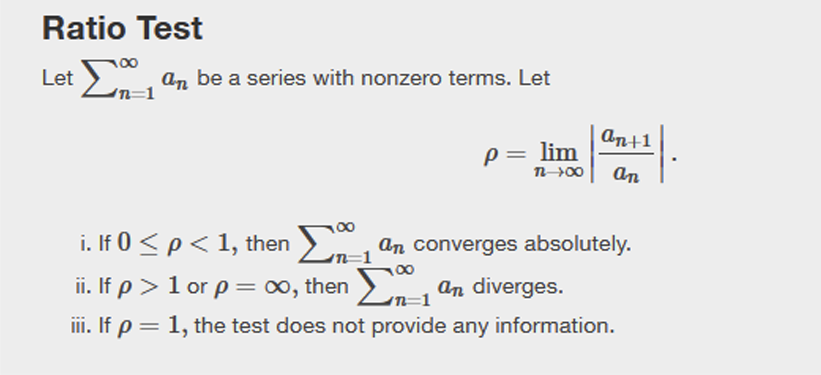
Notice in the procedure, the value of the limit () is calculated.
If the value of is 1, then the test is inconclusive and other tests must be investigated.
If the value of is between 0 (inclusive) and 1 (exclusive) then the series converges absolutely.
Otherwise the series diverges.
The ratio test is especially useful for series whose terms contain factorials, where the ratio of terms simplifies the expression.
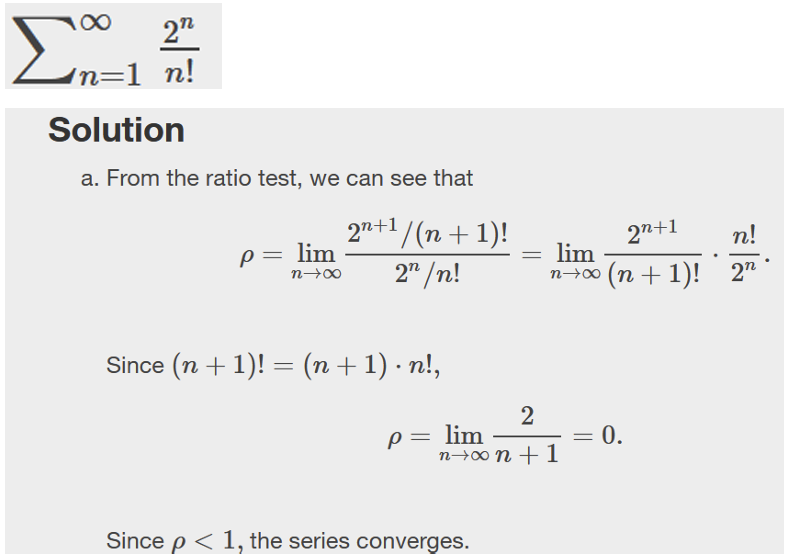
Example:
Use the ratio test to assess the convergence of the following series:
The root test proceeds along the similar method as shown above for the ratio test.
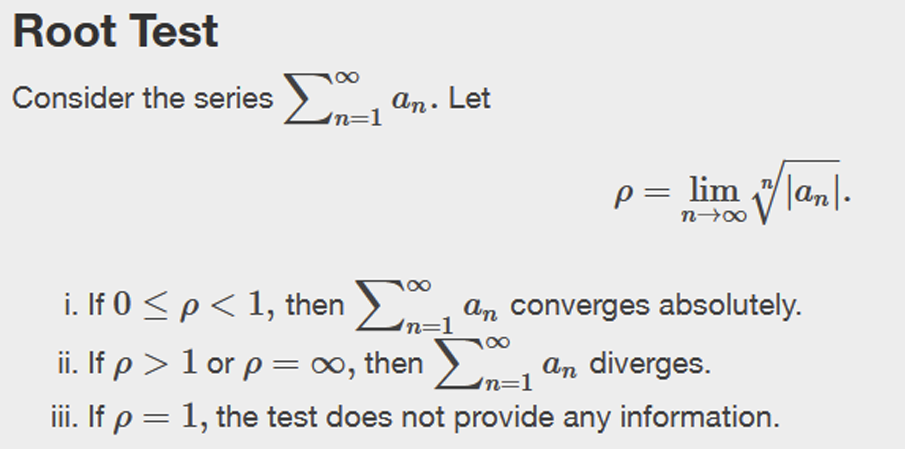
The root test is especially useful for series which contain exponentials. The nth root of the general term of the series is taken and then the limit of this expression is evaluated as n approaches infinity.
Based on the results of this limit, a conclusion may be reached as to convergence or divergence. Similar to the ratio test, note that there is also the possibility that the root test is inconclusive regarding the convergence status, and if this is the case, another test must then be applied to investigate convergence.
Here are the steps needed to utilize the root test to assess convergence status for an infinite series:
Example:
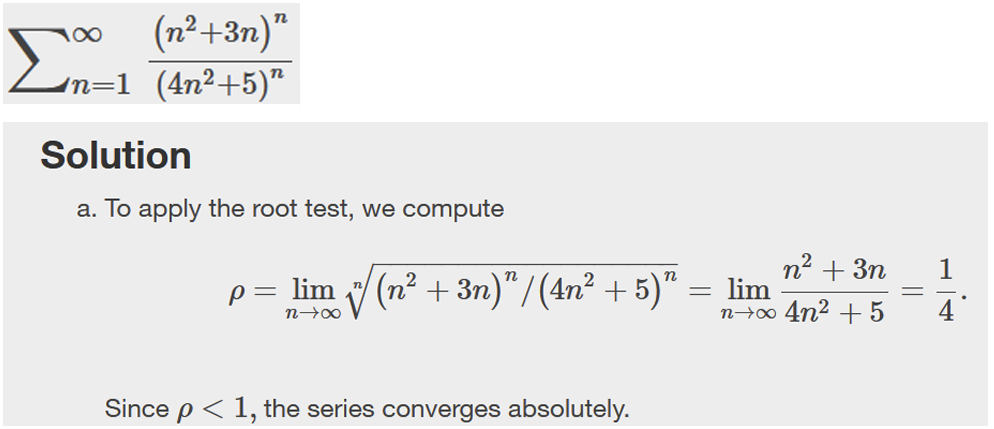
Use the root test to assess the convergence of the following series: