
Dot Product and Cross Product

When working with three dimensional vectors, the dot product and cross product are two essential operations for understanding angles, projections, and perpendicularity in space. The dot product helps determine the angle between vectors and is used in applications such as when calculating work done in physics, while the cross product produces a vector perpendicular to two given vectors, which is useful in torque and the determination of normal vectors to surfaces.
For example, in physics applications, both force and motion can be described using vectors so we would like to understand how to take the dot product of two vectors. For the work analogy, the dot product of the force vector and motion vector tells us how much of the force vector is applied in the direction of the motion vector.
The dot product can also help us measure the angle formed by a pair of vectors and the position of a vector relative to the coordinate axes. The dot product also provides a simple test to determine whether two vectors meet at a right angle. Note that the result of a dot product operation is a scalar.
Another vector operation is called the cross product, which allows us to find a vector orthogonal to two given vectors. Whereas the dot product of two vectors resulted in a scalar, the result of the cross products of two vectors will be a vector.
The video below explores the calculation for both dot product and cross product and also review several applications and worked out examples.
Background
The dot product and cross product are two vector operations used extensively in physics, engineering, business, environmental science and other fields.
The dot product helps determine the angle between vectors and is used in applications such as when calculating work done in physics, while the cross product produces a vector perpendicular to two given vectors, which is useful in torque and the determination of normal vectors to surfaces.
A common application of the dot product is in physics where we are often interested in calculating the work done by a force. Both force and motion can be described using vectors so we would like to understand how to take the dot product of two vectors. For the work analogy, the dot product of the force vector and motion vector tells us how much of the force vector is applied in the direction of the motion vector.
The dot product can also help us measure the angle formed by a pair of vectors and the position of a vector relative to the coordinate axes. The dot product also allows for the determination if two vectors meet at a right angle.
Calculating the Dot Product
To form the dot product of two vectors, the rule is as follows:

Note that the result of a dot product operation is a scalar.
Example:
Find the dot product of \( \mathbf{u} = \langle 3,5,2 \rangle \) and \( \mathbf{v} = \langle -1,3,0 \rangle \).
Solution:

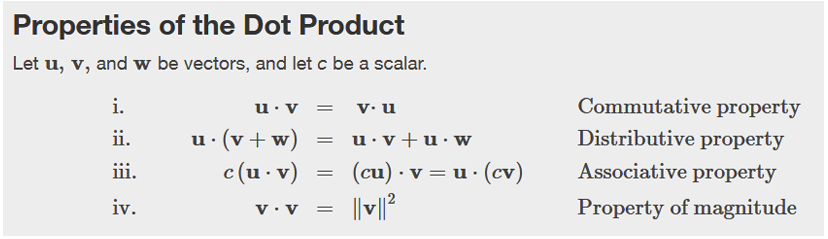
There are several useful algebraic properties of dot products, summarized as follows:
Properties of the Dot Product
The following table summarizes various properties of the dot product operation:
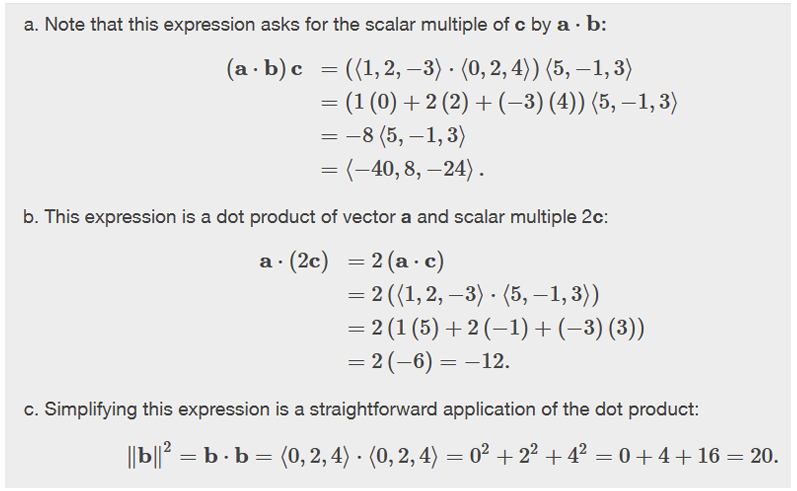
Example:

Solution:
Finding the Angle between Two Vectors
Another application for the dot product is to find the measure of the angle between two vectors. This property is a result of the fact that we can express the dot product in terms of the cosine of the angle θ formed by two vectors.
The following formula relates the cosine of the angle between two vectors using the dot product:
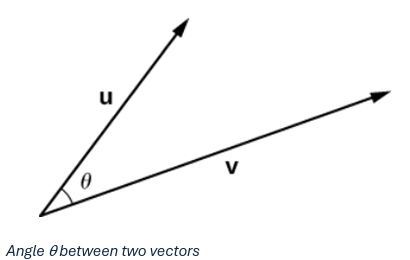
The dot product of two vectors is the product of the magnitude of each vector and the cosine of the angle between them:
\[ u \cdot v = ||u||\text{ }||v|| \cos \theta . \]
Example:
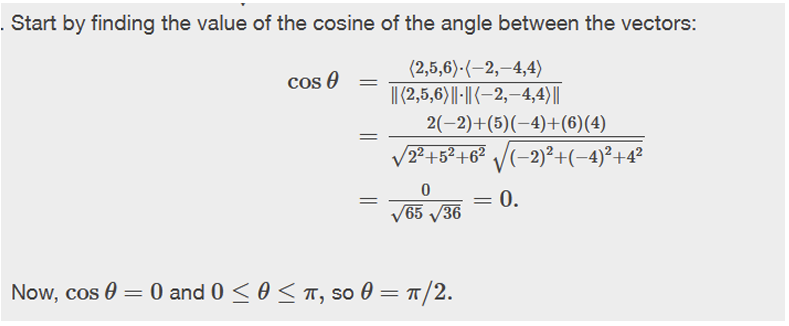
Find the measure of the angle between the two vectors: \( \langle 2,5,6 \rangle \) and \( \langle -2,-4,4 \rangle \)
Solution:
Orthogonal Vectors
Orthogonal vectors are vectors that have an angle of 90° between them. You can also consider this as the vectors crossing at right angles to one another.
To determine if two vectors are orthogonal, check the result of the dot product. If the result of the dot product is zero, then the vectors are orthogonal.
Orthogonal Vectors
The nonzero vectors u and v are orthogonal vectors if and only if \( u \cdot v = 0\).
Example:
Determine whether \( \mathbf{p} = \langle 1,0,5 \rangle \) and \( \mathbf{q} = \langle 10,3,-2 \rangle \) are orthogonal vectors.
Solution:

Work Done by a Force
A common application for the dot product is in calculating the work done by a force. Keep in mind that the direction of the force may be different from the direction of motion. To find the work done, we need to multiply the component of the force that acts in the direction of the motion by the magnitude of the displacement. The dot product allows us to do just that. If we represent an applied force by a vector F and the displacement of an object by a vector s, then the work done by the force is the dot product of F and s.

Example:
Suppose a child is pulling a wagon with a force having a magnitude of 8 lb on the handle at an angle of 55°. If the child pulls the wagon 50 ft, find the work done by the force.
Solution:

Cross Product
Another vector operation is called the cross product, which allows us to find a vector orthogonal to two given vectors. Whereas the dot product of two vectors resulted in a scalar, the result of the cross products of two vectors will be a vector.
When we form the cross product of two vectors, written as \( \mathbf{u} \times \mathbf{v} \), the result is a vector that is orthogonal to both vectors u and v.
The cross product is defined as follow:

Note that the direction of \( \mathbf{u} \times \mathbf{v} \) is given by the right-hand rule. If we hold the right hand out with the fingers pointing in the direction of u, then curl the fingers toward vector, the thumb points in the direction of the cross product.
Example:
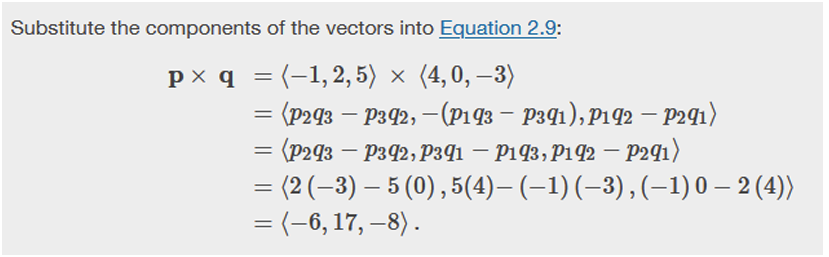
Find the cross-product \( \mathbf{p} \times \mathbf{q} \) where \( \mathbf{p} = \langle -1,2,5 \rangle \) and \( \mathbf{q} = \langle 4,0,-3 \rangle \)
Solution:
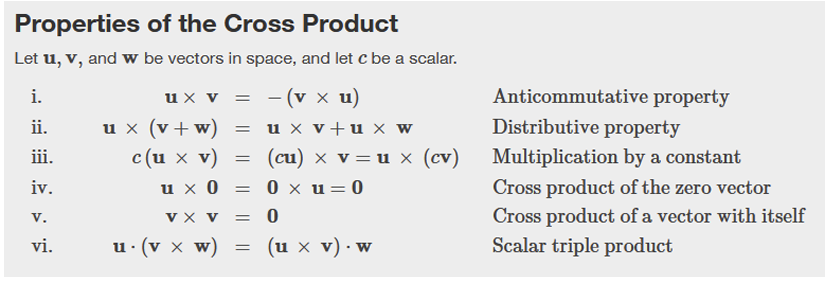
The table below provides various properties of the cross product, such as the distributive property, multiplication by a constant, etc.:
Example:
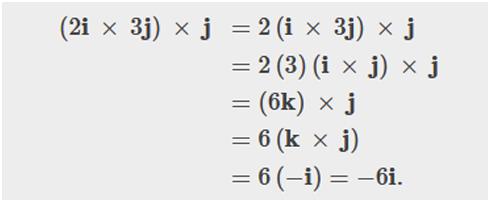
Use the properties of the cross product to calculate \( (2\mathbf{i} \times 3\mathbf{j}) \times \mathbf{j} \).
Solution:
Magnitude of the Cross Product
To calculate the magnitude of \( \mathbf{u} \times \mathbf{v} \), multiply the magnitudes of u and v, and the sine of the angle between them.

Example:
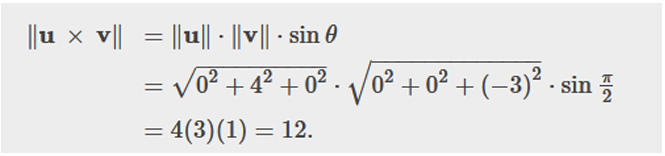
Find the magnitude of the cross product of \( \mathbf{u} = \langle 0,4,0 \rangle \) and \( \mathbf{v} = \langle 0,0,-3 \rangle \).
Solution:
Applications of the Cross Product
The cross product appears in many practical applications in mathematics, physics, and engineering. Common applications include calculation of torque and use in gravitational and electromagnetic fields.
Torque measures the tendency of a force to produce rotation about an axis of rotation. Let r be a vector with an initial point located on the axis of rotation and with a terminal point located at the point where the force is applied, and let vector F represent the force. Then torque is equal to the cross product of r and F:
Torque \( \boldsymbol{\tau} = \mathbf{r} \times \mathbf{F} \)
Example:
A bolt is tightened by applying a force of 6 N to a 0.15-m wrench. The angle between the wrench and the force vector is 40°. Find the magnitude of the torque about the center of the bolt. Round the answer to two decimal places.
Solution:

