Governance Isn’t Glamorous. It’s Everything.
Most presidents blame “market forces” for decline. The real problem? Your governance structure wasn’t built for 2025.
Written by Dr. Melik Peter Khoury
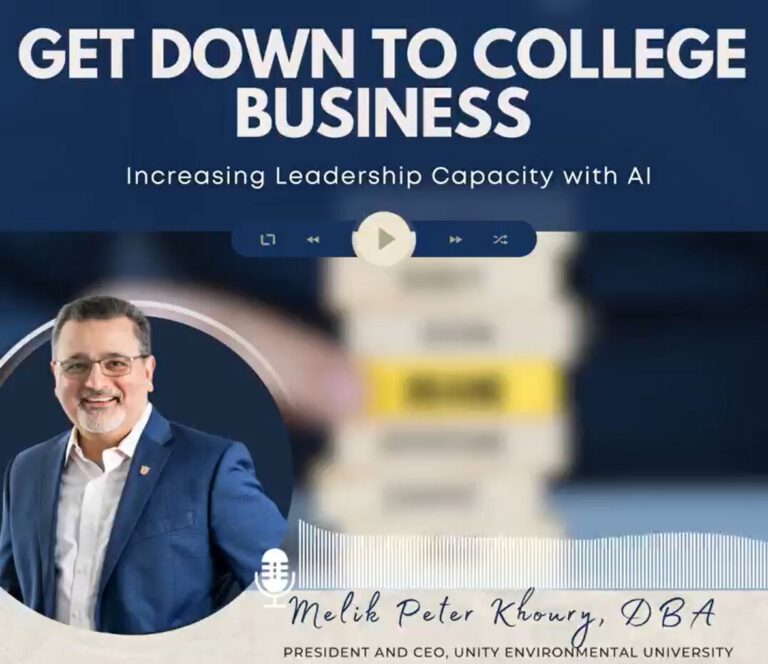
I had the privilege of sitting down with Brad Fuster on the EdUp Innovation podcast this week to talk about something most higher education leaders avoid discussing in public… Governance. Not strategic plans. Not vision statements. Not innovation theater… Governance. The unsexy backbone that either enables transformation or suffocates it.
Here’s what we unpacked during our conversation, and why it matters for anyone trying to lead change in higher education right now.
The Governance Trap
Most institutions treat governance like compliance paperwork. Board meetings become performance reviews. Committees multiply like rabbits. Decision-making slows to a crawl because nobody wants to be the one who broke tradition.
Meanwhile, the world outside moves at digital speed. Student preferences shift. Market dynamics change. Competitors emerge from unexpected places.
Traditional governance structures weren’t built for this velocity. They were built for stability in a world that no longer exists.
How We Rewired Unity
When Unity faced its crossroads in 2018, we had a choice. We could hunker down and hope the storm passed, or we could fundamentally restructure how we made decisions and allocated resources.
We chose the latter. Not because we’re brave, but because we had no other viable option.
We reimagined governance to create what I call “strategic agility.” Decision rights got pushed closer to the action. Board structure evolved to match our growth trajectory. We built feedback loops that actually fed back into operations.
The result? We grew enrollment from under 600 over 10X in growth. We cut tuition from $29,000 to $13,000. We launched new programs in weeks, not years. We built Una, our AI agent, because governance structures allowed us to experiment rapidly.
None of that happens without rethinking who decides what, and how fast they can move.
The Questions Nobody Wants to Ask
During our conversation, Brad and I explored some uncomfortable territory. Questions like:
How many of your board members understand the business model you’re actually operating under today?
When was the last time a governance decision accelerated something rather than just approving it?
What percentage of your committee work actually drives institutional outcomes versus checking boxes?
If you had to start from scratch, would you design your current governance structure?
These aren’t rhetorical questions. They’re diagnostic tools. And most institutions would fail the diagnostic.
What Governance-Driven Transformation Looks Like
In our conversation, I outlined how modernized governance became Unity’s competitive advantage. Not mission statements or marketing campaigns. Governance.
When your board understands they’re stewards of transformation rather than guardians of tradition, everything changes. When committees exist to solve problems rather than study them, momentum builds. When decision-making happens at the speed of opportunity rather than the speed of bureaucracy, you can actually compete.
Unity operates on an 8-term academic calendar with 5-week terms. We launch programs that respond to market signals in real time. We’ve built institutional infrastructure that treats change as normal rather than threatening.
None of that was possible under our old governance model. All of it became possible once we rewired how decisions flowed through the institution.
The Blueprint Exists
I’m not claiming Unity figured everything out. We’re still learning, still adapting, still making mistakes. But we proved something important: governance transformation isn’t theoretical. It’s practical, it’s measurable, and it’s replicable.
For trustees grappling with enrollment declines, this matters. For presidents feeling trapped between aspiration and inertia, this matters. For faculty leaders wondering why everything moves so slowly, this matters.
The institutions that thrive over the next decade won’t be the ones with the best strategic plans. They’ll be the ones whose governance structures enable them to execute faster, adapt smarter, and compete more effectively than peers still operating under 20th-century decision-making models.
Listen and Let’s Talk
If you’re curious about how we actually did this, or if you’re wrestling with similar challenges at your institution, I’d encourage you to listen to the full conversation with Brad. We went deep on the specifics, the trade-offs, and the leadership philosophy required to pull this off.
And then let’s talk. Reach out to me and share your own governance war stories. Higher education needs more honest conversations about the structural changes required to survive, not just survive but thrive in this environment.
Governance isn’t glamorous. But it’s everything. And it might be the one lever your institution hasn’t pulled yet.
Until next time..