Higher education is out of time to make its case. Families stopped taking the value of a degree on faith. Employers want evidence of what a graduate can actually do, not a transcript that implies it. Federal student aid is being rewritten under institutions that built their budgets on the assumption it never would be. Colleges are closing. Others are merging quietly after years of delay that cost them every ounce of leverage they had.
That is the hard part, and I will not soften it for you. You deserve the same candor I give our board and our employees. Here is the other part.
Unity spent the last decade building for this moment instead of bracing for it. Not because we predicted the specifics. Nobody did. We built an institution designed to adapt, and adaptation is what the moment is now demanding of everyone.
The record, not the promise
More than 10,000 students from all 50 states learn with Unity, with our top three states being Texas, Florida, and California. Today, I’m proud to say we now have more students from Maine enrolled in Unity programming than at any other time in our history. Thirty-one percent of them are the first in their families to attend college. Seventy-two percent receive Pell Grants. Eighty-seven percent of our recent graduates are employed or continuing their education within six months of finishing.
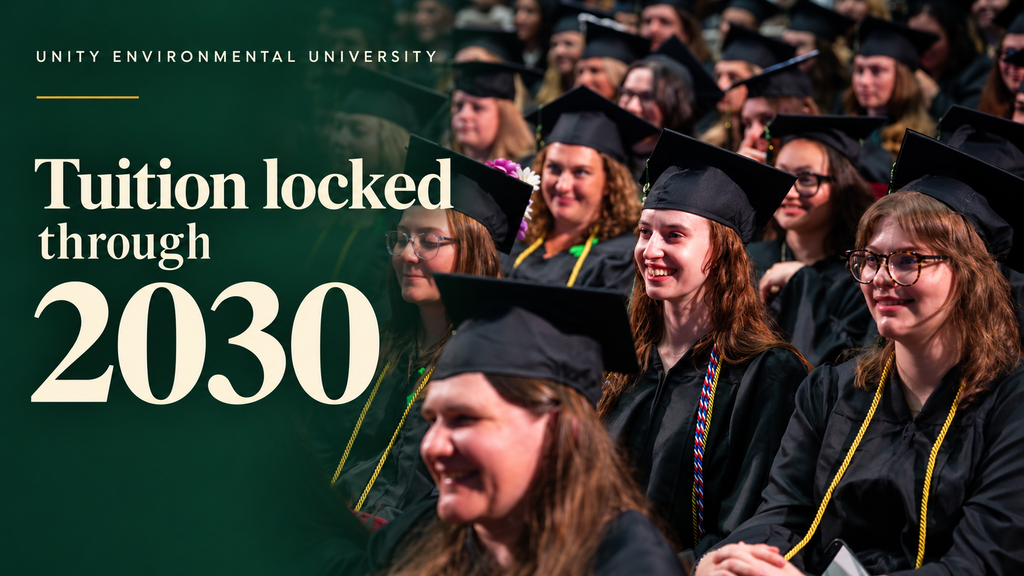
Our tuition is locked through 2030 at $470 per credit online and $375 per credit at Pineland. Ninety-eight percent of our students finance their degree without touching a private loan. There are no technology fees, no activity fees, no mandatory meal plans, no required housing. When federal aid rules changed this year, our students felt almost none of it, because affordability at Unity is a structure and not a discount.
We are in the top one percent of universities nationally for social mobility. That is not a marketing line. It is an outcome, measured by someone other than us. We did not get there by protecting a model. We got there by rebuilding one.
What that rebuilding looks like right now

Our 90-credit Applied Bachelor’s degrees, the first fully accredited degrees of their kind in Maine, let students finish faster and start earning sooner. Time is the cost families feel most, and we treated it that way.
Una, our AI ecosystem, answers the question that arrives at midnight when no staff member is awake to take it. Una works alongside our advisors and faculty rather than in place of them. It absorbs the routine so our people can spend their hours on the conversations that change a student’s direction. Una is still being built, and I would rather tell you that than oversell it.
Our new Career Hub is not a job board. It is a curated network of employers who want Unity graduates specifically, connected directly to our Career Services team.
The Couri Graduate School of Business exists because Elaine and John Couri, their family, and their friends put $500,000 behind an idea, and Unity matched it with $250,000 to create a $750,000 endowment aimed entirely at students. Grants. Internships. Experiential learning. Immersion.
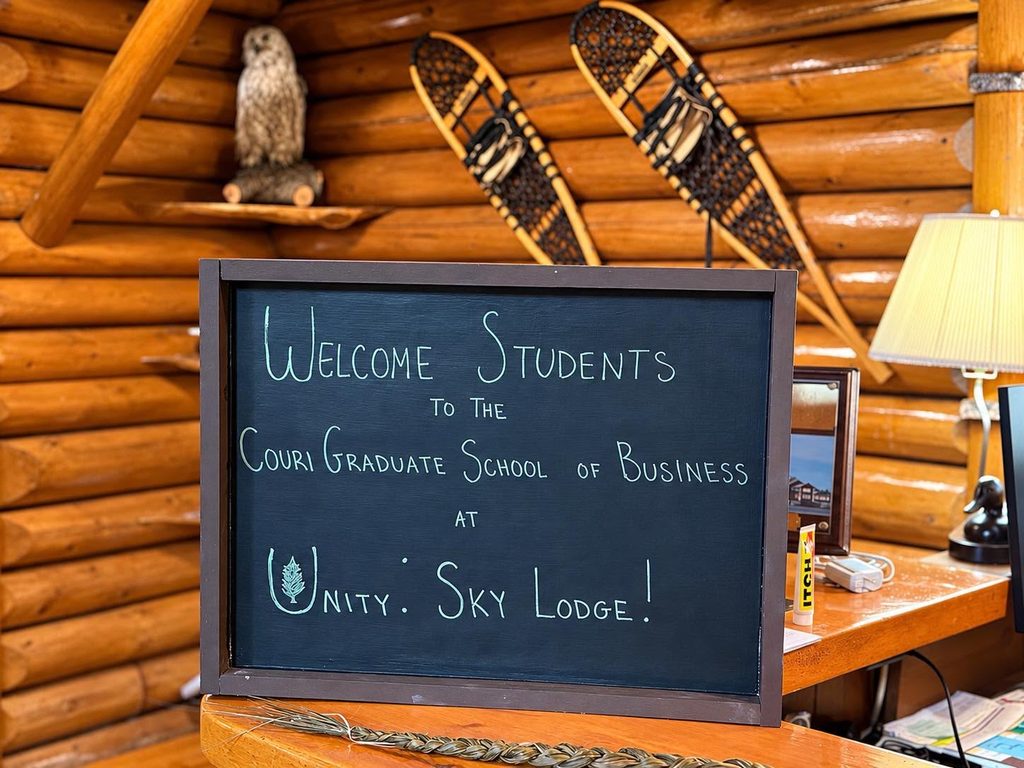

In June, we welcomed the first Couri Graduate School of Business cohort, professionals ready to connect business leadership with purpose. In July, John Couri joined myself along with local and regional leaders for the School’s formal ribbon cutting.
And this summer, Upward Bound and Bridge Academy brought young people onto our doorstep who had never pictured themselves in a university at all. Building for what comes next means widening who gets to come with us.
Why the urgency is real
Every year an institution waits, students pay the interest on that delay. In debt they should not carry. In degrees that take longer than their lives allow. In credentials employers have quietly stopped trusting.
We have never had the luxury of waiting. Unity started in 1965 with almost nothing but conviction. We were the first college in the country to divest fossil fuels from our endowment.
We rebuilt ourselves as America’s Environmental University when the safer choice was to stay small and stay quiet. Every one of those decisions looked risky at the time. Every one of them looks obvious now. The next decade will hand us the same kind of choice, more than once.
Where you come in
You are the part of this that technology cannot build.
Open a door: If your organization hires, mentors, or takes on interns, put it in front of our students through the Career Hub. A single introduction from you is worth more than a thousand impressions of our advertising.
Tell someone: First-generation students often need one person to say out loud that this is possible for them. You are already that person for somebody.
Invest if you can: Every dollar into student-facing funds turns directly into someone’s tuition, someone’s fieldwork, someone’s first professional opportunity.
I do not know precisely what higher education looks like in ten years. Anyone who claims to is selling something. What I know is that the institutions still standing will be the ones that questioned their own assumptions before circumstances forced the question.
We asked ourselves early. We are still asking.
The future is not something we are waiting for. We are already building inside it, and you are part of the reason it holds.