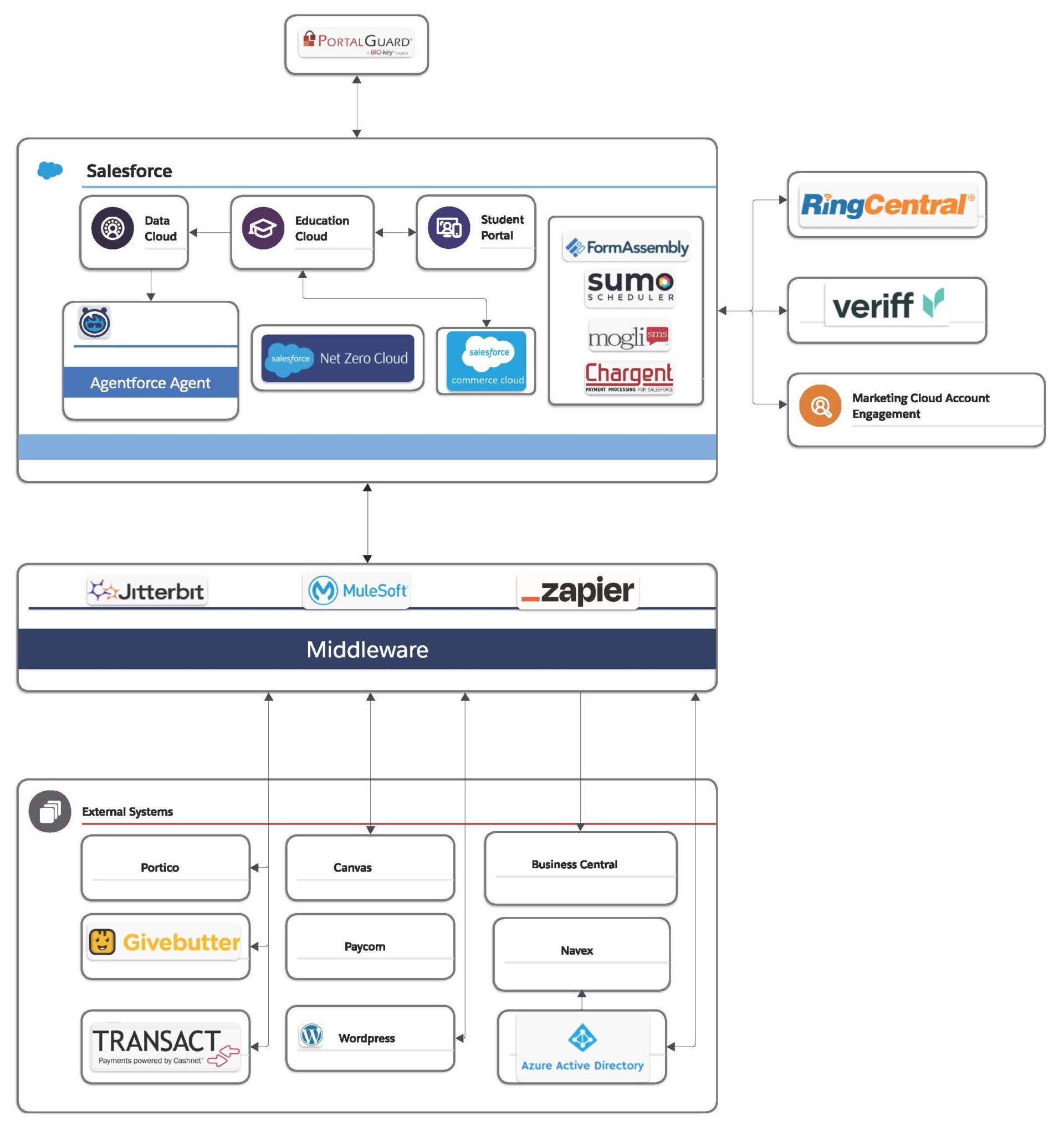
The Systems That Support Stratus
The Stratus Technology Stack represents the systems that support the university’s operating model. These technologies are intentionally selected, integrated, and governed to function as part of a unified institutional environment rather than as standalone tools.
The purpose of the technology stack is not to define how the university operates, but to enable consistent execution, reliable data, and scalable operations across the institution. Systems provide capability. Stratus provides structure, alignment, and control.
For example, processes such as degree audit, advisor assignment, and academic progress tracking operate in real time across the institution rather than through manual coordination across teams. This reduces delays, improves accuracy, and ensures that students and staff are working from the same information.
Technologies are incorporated into Stratus only when they align with shared data definitions, support standardized processes, and can be governed within the institutional model. This approach ensures that the addition of new tools strengthens the overall environment rather than introducing fragmentation or duplicative workflows.
How Technology Supports the Student Experience
Students experience Stratus through a set of connected digital services that provide consistent access to academic, financial, and support information. These services operate as part of a coordinated system, ensuring that information is accurate, timely, and aligned across the learner lifecycle.
Rather than navigating disconnected platforms, students interact with an environment where:
- Academic progress, advising, and course activity are connected and visible
- Financial aid and account information are accessible through integrated services
- Learning environments support both instruction and engagement
- Career resources are connected to academic pathways
These capabilities reduce friction, improve clarity, and allow students to focus on learning and progression rather than navigating systems.
Technology for Institutional Execution and Decision-Making
Beyond student-facing services, the Stratus Technology Stack provides the infrastructure necessary for the university to operate with consistency and control.
Integrated systems ensure that institutional data is structured, reliable, and available in real time. Automated workflows reduce manual coordination across teams, eliminating delays that previously required cross-functional handoffs and enabling processes such as enrollment updates, advising actions, and academic tracking to occur continuously.
This foundation enables:
- Consistent and accurate institutional reporting
- Real-time visibility into enrollment, academic progress, and engagement
- More informed and timely decision-making
- Reduced operational and compliance risk through standardized processes
Technology supports execution, but it is the alignment of data, process, and governance that ensures the institution operates effectively.
A Technology Stack That Evolves with the Institution
The Stratus Technology Stack is designed to evolve as institutional needs change. New systems can be introduced, and existing tools can be replaced, without disrupting the broader operating model.
This flexibility ensures that the university can adapt to new academic models, enrollment strategies, and regulatory requirements while maintaining consistency, reliability, and control.
Stratus is not defined by the tools it uses. It is defined by the institution’s ability to operate as a coordinated, data-informed system over time.