

Why We’re Different: The Disaggregated Faculty Advantage
Traditionally, a single college professor is expected to manage a massive workload: teaching, conducting research, advising students, designing online and in-person course curriculum, serving as a subject matter expert, and managing program assessments.
At Unity Environmental University, we believe our students deserve better than a “one-size-fits-all” academic structure. We have pioneered a disaggregated faculty model by unbundling the traditional professor role into seven specialized and scoped positions. By distributing these duties to dedicated professionals, each member of our faculty can focus 100% of their energy on their core strength. The result for our learners is a higher-quality educational experience, more flexible learning paths, and robust, personalized student support.
Our Seven Specialized Faculty Roles
Each role carries one defined body of work.
- Academic Advisors: Specialized student success partners. Advisors help students construct academic plans aligned with their specific career goals, navigate the learning management system (LMS), secure internships, utilize tutoring tools, and prepare for the job market.
- Academic Deans: Academic program managers responsible for staffing and developing our curriculum. They collaborate directly with external industry stakeholders to ensure our academic programming meets modern career standards.
- Enterprise Assessors: Curricular assessors focused on institutional quality assurance. They evaluate the overarching effectiveness of our academic programming, establish rigid quality policies, and maintain strict compliance with regulatory and accreditation standards.
- Instructional Designers: Learning experience architects who design the modern classroom. They establish clear, measurable learning outcomes and sequence dynamic activities so that curriculum is engaging, highly accessible, and grounded in real-world scenarios.
- Instructors: Dedicated teaching faculty completely focused on facilitating learner engagement across multiple modalities, assessing student achievement, and providing rich, constructive feedback.
- Scholars & Researchers: Thought leaders dedicated to generating fresh knowledge, conducting scientific research, publishing findings, and advancing the university’s intellectual contributions to the wider world.
- Subject Matter Experts: Industry practitioners and discipline experts focused on communicating cutting-edge expertise, professional insights, and real-world environmental applications directly to our student body.
Modularity in Action: Flexible Roles for Strategic Needs
Although we have disaggregated these important bodies of work to ensure academic excellence, these roles are not mutually exclusive. Disaggregation gives us the structural precision to understand exactly what goes into a world-class education, but it also gives us incredible operational flexibility.
Unity operates on an enterprise model. Core functions such as academic administration, information technology, human resources, finance, and physical assets are standardized across the University, while distinct Sustainable Education Business Units (SEBUs) develop audience-focused programs, products, and services. Unity Distance Education, Unity at Pineland, and Sustainable Ventures are each a SEBU, designed around the learners and markets they serve.
This structure also allows Unity to configure faculty roles based on program and delivery needs. A faculty position might blend elements of an Instructor and a Scholar or combine Subject Matter Expertise with Instructional Design. By defining these functions independently, Unity can intentionally combine them to create faculty positions aligned with the academic, learner, and operational requirements of each SEBU.
What We Do Not Combine
Not every combination is permitted. Two principles govern how every faculty position at Unity is constructed.
Principle 1: Continuity of guidance stays separate from evaluation.
An Academic Advisor is a learner’s single point of contact through their journey, the one consistent voice guiding them through the complexity of degree requirements, resources, and decisions from enrollment to graduation. That relationship depends on a student being able to speak candidly about where they’re struggling, without consequence for their grades. For that reason, advisors do not serve as instructors of record for the students they advise. This preserves two distinct points of contact for every course, the Instructor and the Advisor, so the person delivering and evaluating a student’s work is never the same person guiding them through it.
Principle 2: Quality assurance stays separate from delivery.
Enterprise Assessors evaluate curriculum, learning outcomes, and institutional effectiveness. That evaluation only means something if it is independent, so assessors do not review programs they teach in or courses they designed. Academic Deans take part in the review of their programs by collecting required data, preparing a program report, and meeting with external reviewers to provide context, but Enterprise Assessors manage the process, finalize the results, and communicate them to the rest of the university. For the same reason, course substitutions and course mapping are handled by Student Success, Deans, and the Registrar’s Office, not by the instructors or advisors working directly with the student.
Other roles are available for combination, and we combine deliberately, based on what a given SEBU’s learners actually need.
Two Positions, Built Two Ways
Applied Baccalaureate Program, Online
A working environmental compliance officer joins Unity as a Subject Matter Expert and Instructor. She brings current regulatory practice into the course and teaches it directly, but she does not build the course. That work belongs to an Instructional Designer, who ensures the course meets accessibility and instructional design standards independent of who is teaching it. She also does not advise her students; their Academic Advisor sits within Distance Education. Instruction and course design are kept separate here, and distance education leans on that separation by staffing more Instructional Designers relative to full-time instructors.
Baccalaureate In-Person Program
A field ecologist joins Unity as a Scholar & Researcher and Instructor, splitting his time between an active research program and teaching courses, with students working alongside him in the field. Research and instruction draw on the same content expertise, so the combination is permitted. He does not serve as Academic Advisor to the students he teaches, and he does not assess the program he teaches in. In-person programs like this one lean on more full-time faculty carrying the combined research-and-teaching line directly, rather than distributing that work across separate roles.
One faculty member carries all seven roles, and the learner competes with the rest of the stack for attention.
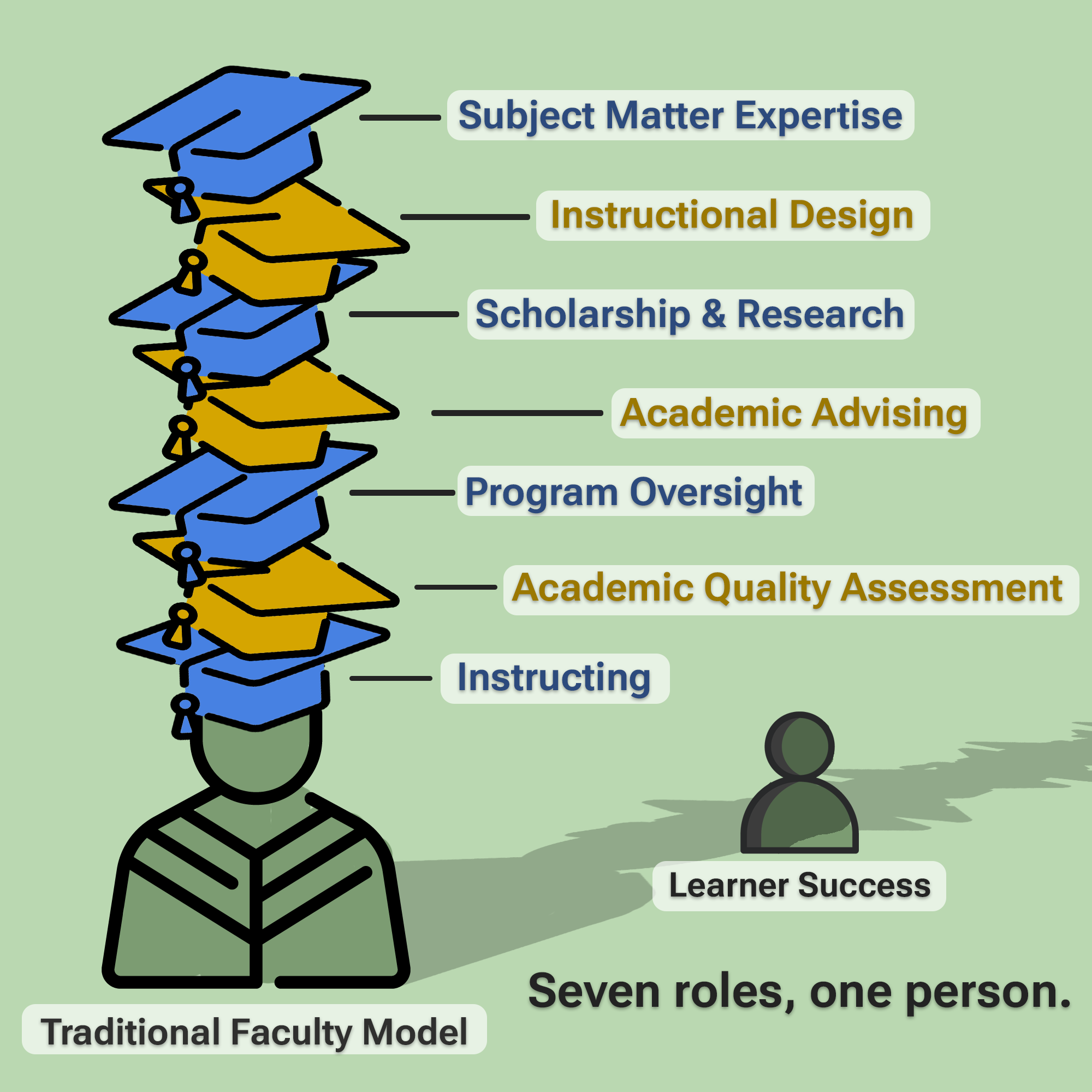
Each role is held by a specialist, and every role is directed at supporting learner success.

Subject Matter Expert
Role: Industry practitioner and discipline expert who brings current professional practice, technical expertise, and real-world application directly into the learning experience. Modularity Flex: In workforce-focused SEBUs, this role is often combined with the Instructor role so learners are taught directly by active professionals with current industry experience. An Enterprise Assessor may also serve as a Subject Matter Expert for programs outside those they assess. Modality: In in-person programs, the Subject Matter Expert and the Instructor are most often the same person, bringing current field practice straight into the classroom or field site. Distance education uses the pairing as well, with an Instructional Designer building the course around the expert’s content.
Instructor
Role: Facilitates learner engagement, assesses student achievement, and provides meaningful feedback that supports academic success. Modularity Flex: Depending on the SEBU, this role may be paired with the Scholar & Researcher role to connect foundational theory with active research, or with a Subject Matter Expert to provide highly applied instruction. Modality: The ratio of Instructors to Instructional Designers is set by modality rather than chosen. Distance education staffs more Instructional Designers relative to Instructors because course architecture carries more of the learning experience. In-person programs staff more full-time Instructors because the Instructor carries more of it directly.
Scholars & Researchers
Role: Generates new knowledge through research, scholarship, publication, and intellectual leadership that advances both the discipline and the institution. Modularity Flex: In research-intensive or graduate-focused SEBUs, this role may be combined with the Instructor role to integrate emerging scholarship directly into classroom instruction. Modality: This role follows no fixed pattern by modality. Within the limits described in What We Do Not Combine, how research is paired with teaching or other work is decided program by program, whether the program is delivered in person or online.
Academic Dean
Role: Leads academic programs by managing curriculum portfolios, faculty staffing, and industry partnerships while ensuring programs remain aligned with workforce and institutional priorities. Modularity Flex: Smaller or emerging SEBUs may combine this role with Subject Matter Expertise to maintain close alignment between academic quality and market demand. Deans also take part in program review, supplying data, a program report, and context for external reviewers, while Enterprise Assessors lead the review and determine its results. Modality: In-person Deans oversee a larger share of full-time Instructors, reflecting how in-person programs are staffed. In distance education, a Dean’s faculty portfolio includes more Instructional Designers relative to Instructors.
Enterprise Assessors
Role: Evaluates curriculum, learning outcomes, and institutional effectiveness while ensuring continuous quality improvement and compliance with accreditation and regulatory standards. Modularity Flex: Enterprise Assessors may also serve as Subject Matter Experts, contributing discipline expertise to programs they do not assess. In their core work, they lead program review: they manage the process, finalize results, and communicate them across the university, while Academic Deans contribute data, a program report, and context for external reviewers. Modality: Assessment standards are set enterprise-wide and apply the same way to in-person and distance programs, so this role does not change with modality.
Instructional Designer
Role: Designs engaging, accessible learning experiences by developing curriculum, learning outcomes, assessments, and instructional activities. Modularity Flex: Workforce and rapidly evolving SEBUs often combine this role with Subject Matter Expertise to accelerate development of industry-responsive curriculum. Modality: Distance education staffs more Instructional Designers relative to Instructors because course architecture carries more of the learning experience there. In-person programs staff fewer, relying on full-time Instructors to carry delivery directly.
Academic Advisor
Role: Partners with learners to develop individualized academic plans, navigate university resources, support persistence, and prepare for career success. Modularity Flex: This role is not combined with other roles. Modality: Advisors specialize in the resources and support systems of the setting their learners are in, whether that means virtual services and the LMS for distance learners or campus-based services for in-person students.
Putting Student Success at the Center of Higher Education
By re-imagining how a university operates, we ensure that every single educator a learner interacts with has a clear, dedicated focus. In traditional systems, professors have to divide their attention across dozens of competing administrative responsibilities. Our specialized faculty model gives educators the freedom to excel in their distinct scope, allowing our entire ecosystem to adapt much faster to shifting industry trends and individual student needs. When instructors and advisors aren’t stretched thin by administrative duties, they can focus entirely on providing learners with higher-quality attention and more robust support.

How a Specialized Faculty Model Lowers Student Costs
This operational precision directly impacts learners’ bottom line by protecting time and finances. When individuals invest in a college degree, a single scheduling mistake or a mismatched requirement can mean enrolling in a course that doesn’t count toward graduation, driving up tuition costs and delaying career starts.
Because our academic advisors are hyper-focused specialists assigned directly to specific learners, they understand every nuance of the degree path. From day one, learners partner with an expert who maps out a precise, optimized academic plan. There is no guesswork and no filler; students navigate the degree seamlessly, graduate on time, and avoid the heavy financial burden of an unexpected “fifth year” of college.
A Dynamic, Career-Aligned Curriculum Built for the Modern Workplace
That same level of intentional focus extends directly into the virtual or physical classroom. Our courses are built from the ground up by specialized instructional designers who partner with subject matter experts to optimize course access and design career-aligned activities.
To keep this learning environment from ever growing stale, we back our design with a rigorous enterprise assessment system. Our curricular assessors constantly evaluate the curriculum to ensure programmatic learning outcomes are continually refreshed. We do not maintain outdated college programs just for the sake of tradition; if a program no longer serves our students or the job market, it is removed. In its place, we launch new, high-demand programs specifically tailored to meet the evolving requirements of modern employers. The result is a dynamic, current, and exciting curriculum that answers directly to workforce needs and ensures the skills learned are exactly what are needed to successfully transition into the workforce.
What This Means for Our Faculty
A disaggregated model raises a fair question: is this better for the people doing the work?
We believe it is, and the reason is straightforward. The traditional professorship asks one person to be an excellent teacher, a productive researcher, a skilled curriculum designer, an informed advisor, and a committee member and then evaluates them against all of it at once. Very few people can do all of that well, and many who try end up doing several of them at the edge of burnout.
Our model asks something different. Faculty are hired into the work they are genuinely expert in, evaluated on that work rather than against a shifting set of unstated expectations, and given a scope that can be written down, resourced, and defended. Most of the roles described here are full-time, salaried positions with full benefits. We also employ part-time instructors, and teaching is the one role where a working professional may reasonably want to contribute a course or two without leaving their field. We have worked to make those positions genuinely worth holding: part-time faculty at Unity are eligible for retirement benefits, which remains uncommon in higher education, and compensation scales with teaching load rather than sitting at a flat per-course stipend.
It also opens a wider door. A practicing environmental engineer can bring current field expertise to our students as a Subject Matter Expert. A gifted teacher can build a career on teaching without being required to publish. A researcher can pursue serious scholarship without being judged on lecture delivery.
And because positions are built from modular components, careers here can move in more than one direction. An Instructor who develops a research agenda can add a Scholar component. A Subject Matter Expert drawn to curriculum can move toward Instructional Design. Portfolios are revisited as expertise and interests evolve, a lattice rather than a single ladder.
Every structure trades something. Ours trades breadth for depth. A scholar who wants to personally own the research, the design, the teaching, and the advising for a single course will feel that as a real limitation. We made that choice deliberately, and we think our students are better for it.
See current openings at Work At Unity.
